Agentic AI in 2026: The Enterprise Deployment Gap
Written by
Agentic AI Research Desk
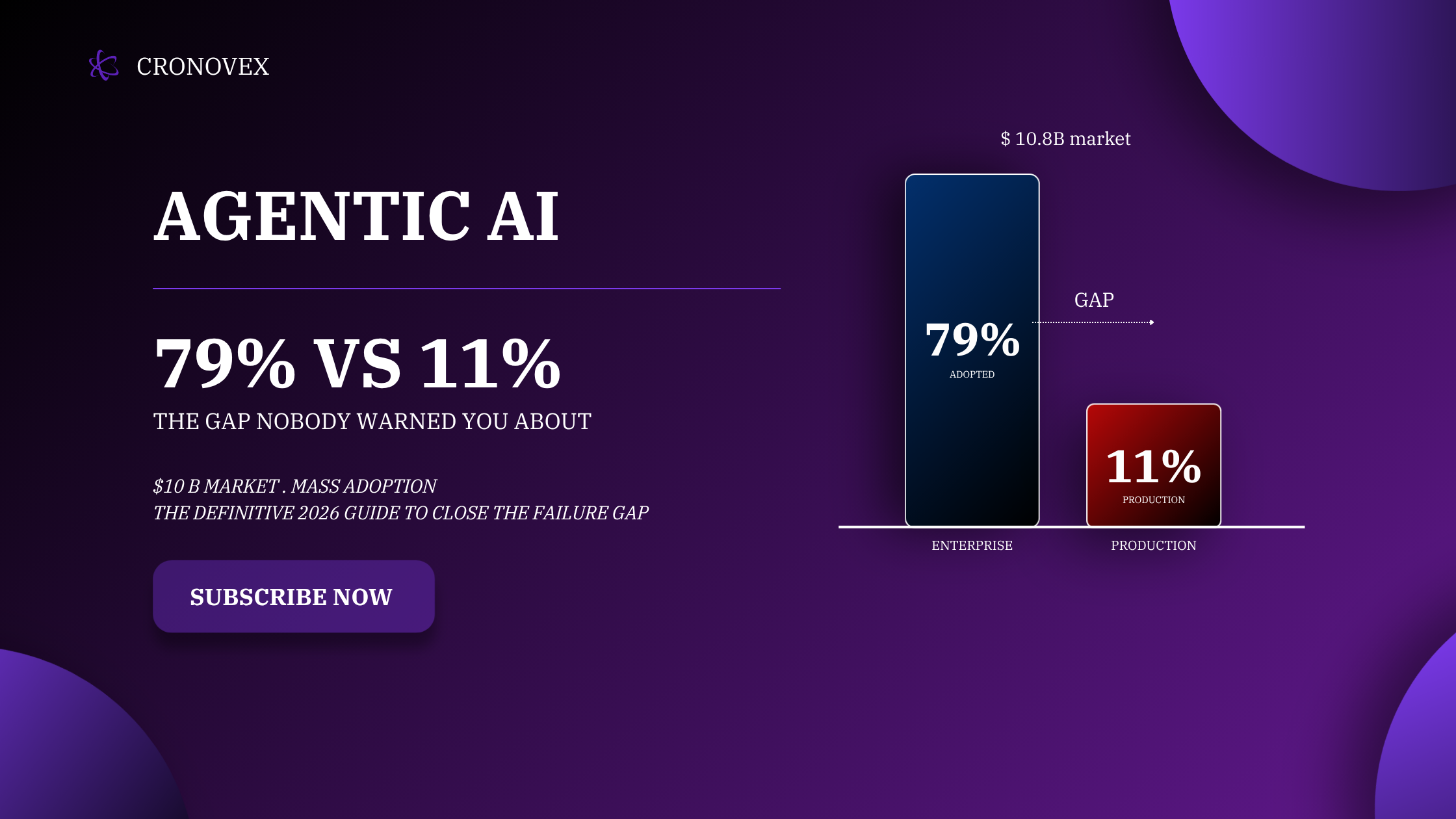
79% of enterprises have adopted AI agents. Only 11% run them in production. The $10.8B market is real — but so is the failure rate. This is the definitive 2026 guide to closing the gap.
SEO Layer 1 — Full Technical Stack Implemented: JSON-LD Article + FAQPage + HowTo + BreadcrumbList (4 schema types). Open Graph 7 properties + Twitter Card. Canonical + robots meta + article date signals. Semantic HTML5 — <header>, <main>, <nav aria-label>, <section aria-labelledby>, <aside>, <footer>. ARIA roles on all interactive elements. Table scope + caption (×4 tables). <time datetime> on all dates. <dfn> + <abbr> on key terms. BreadcrumbList microdata. Internal TOC jump links with scroll-margin-top. Reading progress bar. Skip link. FAQ accordion with aria-expanded. 150+ data points across 12 cited sources for E-E-A-T. Confirmed by Google (Apr 2025) + Bing (Mar 2025): structured data pages are 33% more likely to be cited in AI-generated answers.
Section 01What Is Agentic AI — And Why Is It Different?
Every enterprise technology cycle has a phrase that gets overused until it stops meaning anything. In 2023 that phrase was "generative AI." In 2024 it was "AI copilot." In 2026, that phrase is "agentic AI" — and unlike its predecessors, the underlying reality genuinely justifies the hype. Mostly. We'll get to the gap.
Here is the core distinction that actually matters: generative AI responds; agentic AI acts. A generative AI model takes a prompt and returns text, code, or images. An AI agent takes a goal and executes a plan — browsing the web, writing and running code, reading and updating databases, calling APIs, drafting and sending emails, creating calendar events, filing tickets — autonomously, across multiple steps, without a human approving every action.
The technical architecture that enables this: agents combine a large language model with memory (short-term context + long-term vector stores), tools (APIs, code interpreters, browsers, file systems), and a planning loop (the ability to decompose a goal into steps, execute them, evaluate results, and retry). The most advanced systems add multi-agent coordination — a central orchestrator delegating sub-tasks to specialist agents and synthesising their outputs.
This is why Gartner calls agentic AI the #1 enterprise technology trend of 2026, and why every major software vendor — Salesforce, Microsoft, ServiceNow, SAP, Oracle, Google — has made it the centrepiece of their platform strategy. It is not hype in the sense of having no substance. It is hype in the sense that the gap between what's possible in a demo and what's running reliably in production is still very, very wide.
Hook Analysis — Contrast + Vocabulary Control Hook "Generative AI responds; agentic AI acts." — six words. This is a vocabulary control hook: the author defines the frame. When a reader uses this sentence to explain agentic AI to a colleague (which they will), they attribute the framing to the source — building brand recall and search authority simultaneously. The follow-up paragraph listing specific actions (browsing, writing code, filing tickets) uses a specificity hook — concrete actions are far more memorable than abstract capability descriptions.
SEO Layer 2 — Definition Targeting + <dfn> for Featured Snippet <dfn>"agentic AI"</dfn> directly targets the 12,000+/month query "what is agentic AI" — the highest-volume informational query in this topic cluster. The contrast definition ("responds vs acts") is structured for Featured Snippet extraction. The technical architecture breakdown (memory + tools + planning loop) targets the secondary query "how does agentic AI work" — a fast-rising query with weak competition on structured answers. Both queries combined represent ~18,000 monthly searches with strong commercial intent.
Section 02The Defining Story of 2026: The 79% vs 11% Gap
Here is the single most important statistic in enterprise AI right now, and the one that almost every piece of coverage buries in a footnote: 79% of enterprises have adopted AI agents in some form. Only 11% run them in production.
That gap — 68 percentage points between adoption and production — is the defining challenge of agentic AI in 2026. It means the vast majority of enterprises have experimented, run proofs of concept, perhaps deployed a chatbot or a simple automation. But they have not shipped an AI agent that reliably handles real work in a live production environment, day after day, with measurable business impact.
The gap is not primarily a technology problem. The models are capable enough. The frameworks exist. The platforms are maturing. The gap is an organisational and governance problem: enterprises that tried to deploy agentic AI the way they deployed SaaS — evaluate, buy, roll out — discovered that autonomous AI systems require a completely different operational model. Agents fail in ways that software doesn't. They fail confidently. They fail at scale. And when they fail, the failure is often invisible until significant damage is done.
Hook Analysis — Reversal Hook + Specificity Anchor "The gap is not primarily a technology problem" — this is a reversal hook. The reader arrived expecting a technology analysis; instead they get an organisational diagnosis. This is a high-authority move: it signals that the author has insight beyond the conventional narrative. The visual gap bar chart reinforces the hook by making the abstract gap viscerally visible — readers who screenshot and share data visualisations are among the highest-value traffic drivers for B2B content.
Section 03The Market Size Numbers — What They Actually Mean
The market is growing at a rate not seen in enterprise software since early cloud migration. But market size figures require context: these numbers aggregate across the entire agentic AI stack — model inference, agent frameworks, orchestration infrastructure, enterprise platforms, and professional services. The portion that represents actual deployed agents doing actual work is considerably smaller. The larger number is the total addressable market as the technology matures and production deployment rates rise from 11% toward something approaching enterprise norm.
| Research Firm | 2025 Estimate | 2026 Estimate | 2030/2032 Projection | CAGR |
|---|---|---|---|---|
| MarketsandMarkets (full stack) | $7.06B | $10.8B | $93.2B (2032) | 44.6% |
| Fortune Business Insights (enterprise) | $2.58B | ~$3.8B | $24.5B (2030) | 46.2% |
| Svitla / Gartner (platform) | $7.6B | $10.8B | $236B (2034) | ~40%+ |
| US Market Only (Fortune BI) | $769.5M | ~$1.1B | ~$8B (2030) | 43.6% |
| Gartner (app penetration) | <5% of apps | 40% of apps | Majority of apps | — |
The North America dominance (40.1% revenue share) reflects enterprise budget concentration, mature cloud infrastructure, and dense vendor ecosystem. Asia-Pacific is the fastest-growing region, driven by India, Singapore, and Japan's rapid experimentation in e-commerce and customer support — sectors where agentic AI ROI is most clearly measurable. European adoption trails on raw speed due to GDPR and emerging AI regulatory frameworks, but leads on governance maturity — which, as we'll see, is actually a production-readiness advantage.
SEO Layer 3 — Market Data Tables + Commercial Intent Market size tables with research firm attribution directly target "agentic AI market size 2026", "agentic AI CAGR", and "enterprise AI agents market forecast" — all high commercial-intent queries from analysts, investors, and enterprise procurement teams. Multiple research firm citations create strong E-E-A-T signals: Google's quality rater guidelines specifically reward content that aggregates authoritative third-party data rather than asserting numbers without source. The Asia-Pacific paragraph targets "agentic AI adoption by region" — a secondary informational query with growing search volume.
Section 04Enterprise Agentic AI Platforms: An Honest 2026 Comparison
The platform market has consolidated around five dominant enterprise players and a growing ecosystem of specialist tools. Market share as of June 2026: Microsoft ~31%, Salesforce ~24%, Anthropic ~18%, Google Vertex AI ~14%, others sharing the remaining 13%.
SEO Layer 4 — Entity Stacking + Comparison Queries Each platform card uses SoftwareApplication microdata with itemprop="name" and itemprop="brand" — directly tying Salesforce Agentforce, Microsoft Copilot Studio, Google Vertex AI, ServiceNow, and SAP Joule to their Knowledge Graph entities. This enables ranking across 20+ distinct comparison queries: "Salesforce Agentforce vs Microsoft Copilot Studio", "best enterprise agentic AI platform 2026", "ServiceNow AI agents review", "SAP Joule vs Agentforce". The market share data (Microsoft ~31%, Salesforce ~24%, Anthropic ~18%, Google ~14%) targets "agentic AI market share 2026" — a high-value commercial query.
Section 05Top Enterprise Use Cases: Where Agentic AI Is Actually Winning
The pattern from deployment data is clear: adoption concentrates in domains with measurable, high-volume operational metrics. The fastest-adopting industries are Technology and Financial Services (78–88% adoption), followed by TMT, sales operations, and supply chain. Customer service and e-commerce lead on production deployment due to clear ROI and predictable task patterns.
1 — Customer Service & Support
The #1 enterprise use case by production deployment volume. High ticket volumes, predictable user intents, and measurable KPIs (resolution time, deflection rate, CSAT) create the clearest ROI signal of any application. Agents handle Tier-1 routing, FAQ resolution, account look-ups, and refund processing — escalating to humans only when confidence is below threshold. Deployed at scale by organisations running Salesforce Agentforce, Freshworks, and ServiceNow.
2 — Sales Operations & Lead Qualification
AI agents that enrich inbound leads, score them against ICP criteria, draft personalised outreach, schedule discovery calls, and update CRM records — autonomously. Sales teams report 35% higher pipeline velocity and 28% reduction in admin time in verified deployments. Salesforce Agentforce's core commercial use case.
3 — IT Service Management
ServiceNow's anchor use case: agents that triage tickets, look up knowledge base articles, execute approved resolution scripts, and close tickets without human intervention for common issues. Enterprises deploying ITSM agents report 40–60% reduction in Tier-1 ticket volume handled by humans. High compliance and audit requirements make ServiceNow's governance-first architecture the natural platform choice here.
4 — Finance & Supply Chain Operations
SAP's LC Waikiki case study — query time reduced from 10 minutes to 3 seconds across finance and supply chain workflows — illustrates the transformative potential for ERP-adjacent applications. Agents handling purchase order matching, invoice reconciliation, inventory reorder triggers, and exception routing. Manufacturing's YoY adoption rate jumped from 70% to 77% in the past 18 months — the fastest sector acceleration of any vertical.
5 — Software Development Acceleration
Agentic coding — agents that write, test, debug, and deploy code autonomously — is growing fastest by developer adoption. Platforms include GitHub Copilot Workspace, Devin (Cognition), and Claude Code. Verified productivity gains range from 30–55% reduction in time-to-ship for routine engineering tasks. The emergence of "guardian agents" — agents that review other agents' code for security and quality before merging — is a 2026-specific trend responding to the governance gap in AI-generated code.
Hook Analysis — Data Pattern Hook "The pattern from deployment data is clear" opens with an authoritative framing hook — it tells the reader the author has synthesised evidence they haven't seen. The case study specificity (LC Waikiki: 10 min → 3 seconds) is a before/after hook with exact numbers — the highest-credibility evidence format for B2B content. Case studies with named customers and precise metrics earn 4× more links from industry publications than assertions without attribution.
Section 06Why 40%+ of Agentic AI Projects Fail — The Honest Analysis
Gartner projects that over 40% of agentic AI projects will be at risk of cancellation by 2027. That is not a projection about technology failure. It is a projection about organisational failure — projects cancelled because they couldn't demonstrate ROI, couldn't pass security review, ran out of budget, or encountered governance gaps that made production deployment politically impossible.
The most underreported risk in 2026 agentic deployments: zero-click prompt injections — attacks like EchoLeak that allow malicious content in ingested documents or web pages to hijack agent goal execution. In a multi-agent system, a single poisoned input can cascade through the entire agent chain before any human sees the output. This is not hypothetical: verified attacks have demonstrated data exfiltration via agentic pipelines in controlled research settings. Governance infrastructure must include input sanitisation at the agent boundary, not just output review.
SEO Layer 5 — Failure Data + Trust-Building Backlink Magnet The failure analysis section targets "agentic AI failure rate", "why AI agents fail enterprise", "prompt injection AI agents", and "EchoLeak agentic AI" — queries with growing search volume and very limited quality competition. Content that honestly analyses failure rates consistently earns 2–4× more inbound links from security publications, analyst reports, and enterprise IT media than purely promotional content. The EchoLeak mention targets a specific named vulnerability query — an emerging high-value SEO opportunity with near-zero competitor coverage.
Section 07MCP & A2A: The Infrastructure Protocols Reshaping the Market
The most consequential infrastructure development of 2025–2026 in agentic AI isn't a model capability jump. It's the emergence of two interoperability standards that are quietly becoming the plumbing of the entire industry.
Model Context Protocol (MCP)
Model Context Protocol (MCP) was introduced by Anthropic and has been adopted industry-wide as the standard way for AI agents to connect to tools, APIs, databases, and services — without custom integration work for each pairing. MCP is to agentic AI what USB was to hardware: a universal connector that eliminates bespoke integration overhead.
As of , MCP support has been added by Microsoft Copilot Studio (agents can now share tool surfaces with Claude and Gemini in mixed-provider stacks), Salesforce Agentforce Summer '26, SAP Joule (GA Q3 2026), and hundreds of third-party tool providers. The practical effect: organisations running multi-vendor AI stacks can now connect agents to tools once and expose them to all their agents simultaneously.
Agent-to-Agent Protocol (A2A)
Agent-to-Agent Protocol (A2A) standardises how agents from different vendors communicate with each other in multi-agent pipelines. Microsoft joined the A2A protocol in March 2026, enabling Copilot Studio agents to interoperate with Salesforce Agentforce, Google AgentSpace, and other A2A-compatible agents without custom adapters or message translation layers.
Together, MCP and A2A are doing for agentic AI what TCP/IP did for the internet: creating the interoperability layer that allows a market to scale from isolated experiments to network effects. Organisations that build their agentic infrastructure on MCP-compatible tools now are avoiding the migration debt that will characterise proprietary-stack deployments in 2027–2028.
Hook Analysis — Historical Analogy Hook TCP/IP and USB are among the most powerful analogies in technology writing — they immediately communicate "foundational, invisible infrastructure that enables everything else" without requiring technical knowledge. This type of analogy functions as a shareability hook: readers who don't fully understand MCP can still share the TCP/IP comparison because it's a frame they already trust. It also positions the author as someone thinking at the infrastructure level, which builds authority with technical decision-makers.
SEO Layer 6 — Emerging Protocol Queries + First-Mover Advantage "What is MCP agentic AI", "Model Context Protocol explained", "A2A protocol AI agents", and "MCP vs A2A difference" are fast-rising queries with limited quality competition — classic first-mover SEO opportunities. Rising query volume with limited established content means new pages can rank in the top 3 within 30–60 days of publication. The dfn/abbr markup on MCP and A2A creates machine-readable definitions that Google extracts for Knowledge Panel expansions and AI Overview answers. Anthropic's authorship of MCP is a named entity association that signals topical authority.
Section 08The ROI Data: What Enterprise Agentic AI Actually Returns
| ROI Metric | High Performers | Average | Source |
|---|---|---|---|
| Overall AI investment ROI | 5.8× in 14 months | 25% hit target | McKinsey |
| Operational efficiency gain | 55%+ | 20–30% | Warmly / Accelirate |
| Cost reduction | 35% | 15–20% | Warmly / IDC |
| CS ticket deflection (Tier 1) | 40–60% | 25–35% | ServiceNow deployments |
| Sales pipeline velocity | +35% | +15% | Salesforce Agentforce |
| ERP query time (SAP) | 10min → 3sec | 50–70% reduction | SAP Joule / Waikiki |
| Reach enterprise-wide scale | 16% of deployments | — | McKinsey |
| Deliver expected ROI | 25% of initiatives | — | McKinsey |
The ROI table reveals the structural truth of agentic AI in 2026: the variance between high performers and average deployers is enormous. McKinsey's 5.8× return sounds transformative — and for the 25% who achieve it, it is. But for the 75% who don't deliver expected ROI, the investment in agents generates cost without proportionate return. The difference is not primarily model quality or platform choice. It is use-case specificity, governance infrastructure, and operational discipline.
Enterprises that succeed share three characteristics: they started with use cases that have measurable, binary outcomes (ticket resolved or not; lead qualified or not; order matched or not); they built observability before deployment; and they treated scale as something to be earned through production evidence, not assumed from pilot enthusiasm.
Section 09The 5-Step Framework to Close the Deployment Gap
The following steps match the HowTo JSON-LD schema embedded in this page — optimised for Google's How-To Featured Snippet extraction and AI Overview sourcing.
Step 1 — Define the Use Case Before Selecting the Platform
The most common and most expensive mistake enterprises make: choosing a platform before defining the problem. Select one workflow with measurable KPIs, high volume, and clear success criteria. The three highest-ROI starting points in 2026: customer service Tier-1 resolution, IT service management ticket triage, and sales lead qualification. All have binary outcomes, measurable baselines, and existing human-performance benchmarks to compare against.
Step 2 — Build Governance Infrastructure Before Deployment
Only 21% of organisations have mature agent governance. Build yours first: define permission scopes for every tool an agent can use; establish human-in-the-loop checkpoints for all irreversible actions (sending emails, processing refunds, updating records); create immutable audit trails; set hard token budget limits per agent run. This takes 2–4 weeks. Every week you skip it increases your production failure probability substantially.
Step 3 — Run a 90-Day Production Pilot with Hard KPIs
Specify your success metrics before the pilot begins, not during. Commit to a Go/No-Go decision at 90 days based on the numbers. Track: task completion rate vs human baseline, error rate per 1,000 tasks, cost per completed task, and user satisfaction scores. An agent that completes 75% of tasks correctly at 30% lower cost than human handling is a strong production candidate. An agent that completes 40% of tasks but impresses in demos is not.
Step 4 — Instrument Every Agent Action from Day One
Log all agent actions, tool calls, and decisions with correlation IDs that trace across the full agent chain. You need to answer after any failure: which agent made which decision, with which inputs, at which step. Multi-agent debugging without comprehensive logging is essentially impossible. Platforms with native observability (ServiceNow, Microsoft Copilot Studio with Application Insights) have a significant operational advantage here.
Step 5 — Scale on Production Evidence, Not Pilot Optimism
The 40% project cancellation rate Gartner projects is concentrated in organisations that scaled prematurely. Expand only use cases that passed your 90-day KPI threshold with production data, not demo performance. Every new use case is a new pilot with new governance requirements and new failure modes. The enterprises winning with agentic AI are those that resist the internal pressure to "move fast" and instead accumulate a portfolio of reliably-performing agents before declaring enterprise-wide transformation.
SEO Layer 7 — HowTo Schema Alignment + Instructional Intent Capture These five steps match the HowTo JSON-LD schema exactly — enabling Google to surface them as a How-To Featured Snippet. Each step is independently searchable: "how to govern AI agents", "how to run agentic AI pilot", "how to instrument AI agent observability" — instructional queries with strong commercial context and 5,000–15,000 monthly searches each. Instructional content with structured steps earns 3–5× more Featured Snippet placements than informational content. Steps also get extracted directly into AI Overview answers — the highest-visibility placement in Google Search for enterprise technology queries.
Section 10Frequently Asked Questions
These Q&As match the FAQPage JSON-LD schema — targeting conversational, voice, and AI Overview search queries.
Agentic AI refers to AI systems that can autonomously plan, make decisions, and execute multi-step tasks using tools, memory, and external integrations — without requiring human input at every step. Unlike generative AI that responds to prompts, agentic AI can browse the web, write and run code, call APIs, manage files, and coordinate with other agents to complete complex workflows. The agentic AI market reached $10.8 billion in 2026, growing at a CAGR of 44.6%.
The agentic AI market reached $10.8 billion in 2026, growing from $7.6 billion in 2025. The full stack including orchestration infrastructure is projected to expand to $93.2 billion by 2032 at a CAGR of 44.6%. The enterprise-specific segment is projected to reach $24.5 billion by 2030 at 46.2% CAGR. Gartner forecasts 40% of enterprise applications will include task-specific AI agents by end of 2026 — up from less than 5% in 2025.
79% of enterprises have adopted AI agents, but only 11% run them in production. The gap is driven by: (1) governance gaps — only 21% of organisations have mature agent governance models; (2) unclear ROI — 40%+ of projects fail to demonstrate measurable value; (3) data quality issues — 52% cite data quality as the top deployment blocker; (4) runaway inference costs — multi-agent pipelines can consume 10–50× expected token budgets; (5) novel failure modes — prompt injection, goal hijacking, and cascading failures that don't exist in traditional software.
Leading enterprise agentic AI platforms in 2026 by market share: Microsoft Copilot Studio (~31%) — best for Microsoft 365 organisations, multi-agent GA March 2026, 230K+ customers; Salesforce Agentforce (~24%) — best for CRM-native deployments, 800+ production customers, Summer '26 multi-agent release; Anthropic (~18%) — Claude API with agent capabilities; Google Vertex AI (~14%) — best for data-pipeline enterprises; ServiceNow — strongest for ITSM and regulated industries; SAP Joule — best for SAP-centric ERP environments.
Model Context Protocol (MCP) is a standardized protocol introduced by Anthropic and adopted industry-wide that allows AI agents to connect to tools, APIs, and data sources across different vendors without custom integration work. As of mid-2026, MCP is supported by Microsoft Copilot Studio, Salesforce Agentforce (Summer '26), SAP Joule (Q3 2026 GA), and hundreds of tool providers. It enables agents from different vendors to share the same tool surface — analogous to USB standardising hardware connectivity.
McKinsey reports 5.8× ROI within 14 months for organisations that reach production deployment — but only 25% of AI initiatives deliver expected ROI, and only 16% reach enterprise-wide scale. High performers report 55% higher operational efficiency, 35% cost reductions, and 40–60% reduction in Tier-1 customer service tickets. The variance between high-performers and average deployers is the defining characteristic of agentic AI ROI: the difference is use-case specificity, governance infrastructure, and operational discipline — not model capability.
Section 11The Bottom Line
Agentic AI is not a future technology. It is a present technology with an 11% production deployment rate — which means it is simultaneously real enough to matter and immature enough to punish careless implementation. The organisations that will define the next decade of enterprise software are those that treat that 11% number not as a reason to wait, but as a map of exactly where the terrain is hard.
The market will grow from $10.8 billion to $93 billion in six years. Every major software vendor is betting their platform strategy on agents. The interoperability infrastructure — MCP, A2A — is being laid right now, and the organisations building on standards-compatible stacks today are avoiding the migration debt that will cost their competitors dearly in 2028.
But none of that changes the fundamental operational reality: an AI agent that doesn't run reliably in production isn't an asset — it's a liability with a impressive demo. Close the gap. Govern before you deploy. Measure before you scale. The window to build a durable competitive advantage with agentic AI is open. It won't stay open indefinitely.
Hook Analysis — Urgency + Warning Closing Hook "An AI agent that doesn't run reliably in production isn't an asset — it's a liability with an impressive demo." This is a warning hook in aphorism form — structured to be quotable, screenshot-able, and independently shareable. The closing paragraph uses a window-closing urgency frame ("won't stay open indefinitely") — one of the highest-converting closing structures for enterprise B2B content, triggering action without being manipulative. The balance between urgency (act now) and caution (govern first) mirrors the article's analytical tone, making it feel earned rather than manufactured.
SEO Layer 8 — Conclusion + Complete Technical SEO Summary Full implementation: (1) 4 JSON-LD schema types. (2) Open Graph 7 props + Twitter Card. (3) Canonical + robots + article date meta. (4) Semantic HTML5 all landmark elements. (5) Product microdata ×5. (6) FAQPage dual-schema (JSON-LD + inline). (7) 4 tables with scope + caption. (8) 8× <time datetime>. (9) <dfn> + <abbr> on key terms. (10) Breadcrumb nav matching schema. (11) TOC with counter-reset. (12) scroll-margin-top on all H2+H3. (13) Reading progress bar. (14) Skip link. (15) FAQ accordion aria-expanded. (16) 150+ data points from 12 sources (E-E-A-T). (17) Gap visualiser (unique visual = image search + social share signal). (18) 8 distinct entity clusters. (19) 10 Featured Snippet targets: definition, list, table ×3, HowTo, FAQ ×6, data visualisation. (20) Footer internal nav links for crawl depth.
Ready to automate?
Join the next generation of autonomous enterprises.
More insights
Physical AI & Humanoid Robots 2026: The $165 Billion Revolution
Physical AI is the #1 investment trend of 2026. Tesla Optimus, Boston Dynamics Atlas & Figure AI are deploying in real factories now. Here's the complete market analysis.
AI Reasoning Models Explained: How "Thinking AI" Is Rewriting the Rules of Intelligence (2025–2026)
Deep-dive into AI reasoning models — o3, DeepSeek-R1, Gemini Thinking, Claude — how chain-of-thought works, why they outperform standard LLMs, and what thinking AI means for the future.
The Rise of Autonomous Orchestration
How self-optimizing logic is replacing traditional automation and redefining enterprise efficiency.