The Rise of Autonomous Orchestration
Written by
Cronovex Marketing
How self-optimizing logic is replacing traditional automation and redefining enterprise efficiency.
Something fundamentally different is happening in enterprise software right now. Not the incremental "AI adds a button" kind of different. The autonomous orchestration kind — where AI systems don't just respond to commands, they actively plan, delegate, retry, and complete entire workflows without a human holding their hand at every step.
If you've been paying attention, you've felt the ground shift. First came large language models that could write code and summarize documents. Then came AI agents — systems that could take actions, not just produce text. Now we're entering the third phase: orchestration. Multi-agent pipelines. Self-correcting systems. AI that manages other AI.
What Exactly Is Autonomous Orchestration?
Most companies today use "AI" like a really smart intern. You give it a specific prompt, it gives you a specific output, and then you review it and plug that output into the next step of your workflow.
Autonomous orchestration removes the human bottleneck between the steps.
Imagine a customer support workflow. Instead of a chatbot just answering a question, an orchestrated system receives an email about a damaged product, extracts the order number, pings the Shopify API to check the warranty, uses a vision model to verify the attached photo of the damage, decides to approve the replacement, pings the warehouse API to ship a new one, and drafts a personalized apology email to the customer.
All in 4 seconds. All without a human clicking "approve."
The Architecture of Autonomy
Building this requires a completely different tech stack than building a standard SaaS app. At Cronovex, we architecture these systems using three core layers:
- The Logic Engine: This is the brain. It's usually a state machine or a graph-based router (like LangGraph) that decides what needs to happen next based on the current context.
- The Worker Agents: These are specialized, narrow-scope AI models equipped with specific tools. One agent might only have access to your Stripe API and be trained to handle billing logic. Another might only have access to your internal documentation.
- The Memory & Telemetry Layer: Autonomous systems need to remember past actions and self-correct if an API call fails. We use vector databases (like Pinecone) for long-term semantic memory, and rigorous telemetry to log every decision the AI makes for human auditing.
The "Loss of Control" Myth
The biggest hesitation enterprise leaders have about autonomous AI is losing control. "What if the AI hallucinated and gave away free products or deleted our database?"
This is where proper orchestration shines. True enterprise AI is not a black box. It's heavily bounded.
We build "Human-in-the-Loop" (HITL) safeguards directly into the orchestration graph. If the AI is calculating a refund under $50, the graph auto-approves it. If the refund is over $50, the graph pauses execution, sends a Slack message with an "Approve/Reject" button to a manager, and then resumes execution based on the human's input.
You aren't losing control; you're just elevating humans from "doers" to "approvers."
The ROI is Mathematical, Not Theoretical
When you transition from task-level AI to workflow-level orchestration, the ROI curve goes parabolic. You aren't just saving 10 minutes here and there. You are fundamentally decoupling your company's revenue growth from its headcount growth.
In 2024, the companies that win won't be the ones with the most employees. They will be the ones with the most efficient autonomous infrastructure.
Ready to automate?
Join the next generation of autonomous enterprises.
More insights
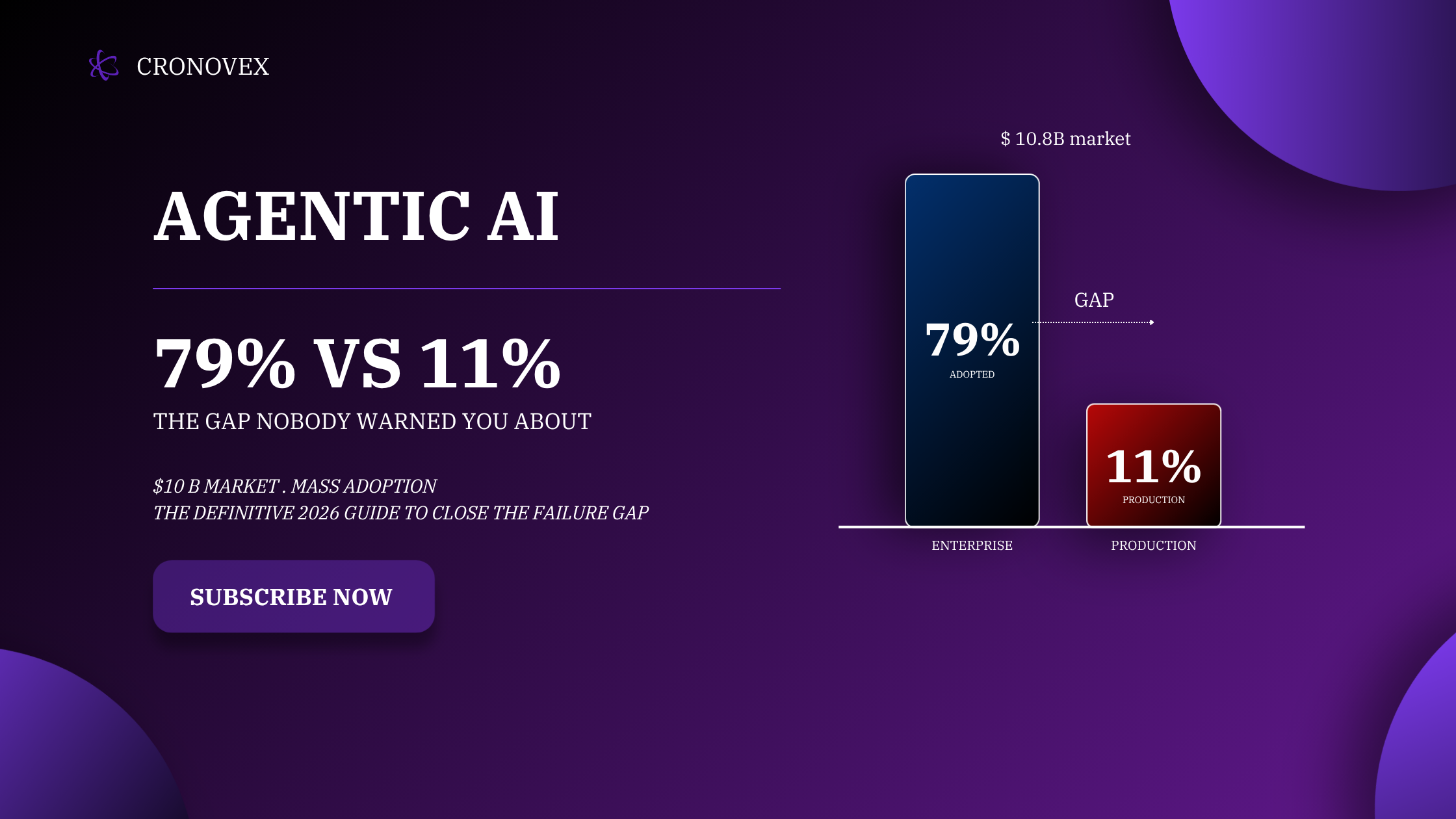
Agentic AI in 2026: The Enterprise Deployment Gap
79% of enterprises have adopted AI agents. Only 11% run them in production. The $10.8B market is real — but so is the failure rate. This is the definitive 2026 guide to closing the gap.
Physical AI & Humanoid Robots 2026: The $165 Billion Revolution
Physical AI is the #1 investment trend of 2026. Tesla Optimus, Boston Dynamics Atlas & Figure AI are deploying in real factories now. Here's the complete market analysis.
AI Reasoning Models Explained: How "Thinking AI" Is Rewriting the Rules of Intelligence (2025–2026)
Deep-dive into AI reasoning models — o3, DeepSeek-R1, Gemini Thinking, Claude — how chain-of-thought works, why they outperform standard LLMs, and what thinking AI means for the future.