AI Reasoning Models Explained: How "Thinking AI" Is Rewriting the Rules of Intelligence (2025–2026)
Written by
Cronovex Marketing
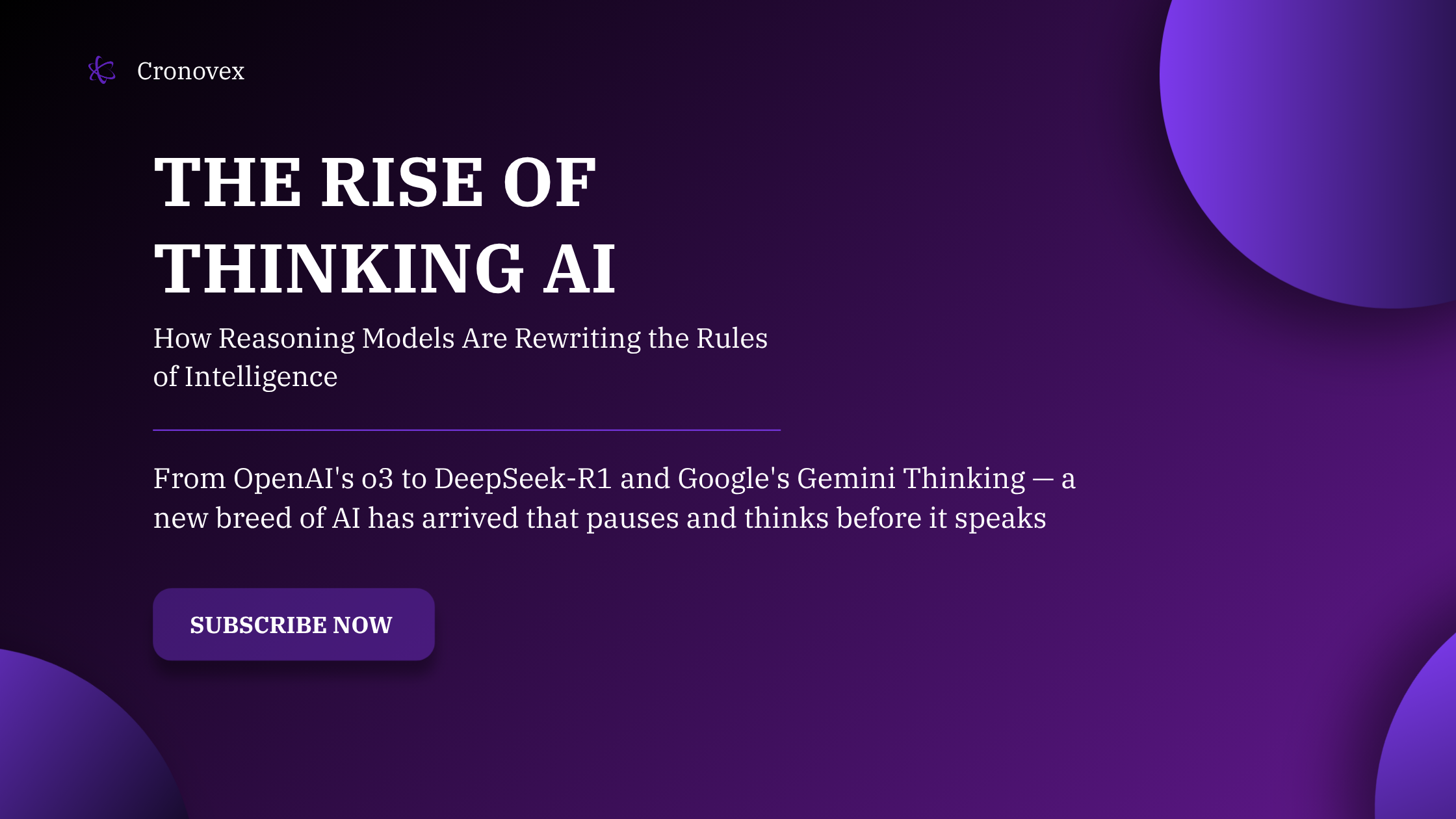
Deep-dive into AI reasoning models — o3, DeepSeek-R1, Gemini Thinking, Claude — how chain-of-thought works, why they outperform standard LLMs, and what thinking AI means for the future.
The field of Artificial Intelligence is shifting from "fast prediction" to "deep reasoning." But what exactly does that mean for enterprise applications? If you're building software today, understanding the difference between standard LLMs and reasoning models is critical for deploying reliable systems.
In this post, we'll break down the architecture of reasoning models, why they hallucinate less, and how Cronovex implements them in high-stakes environments.
System 1 vs System 2 Thinking
To understand reasoning models, it helps to borrow a concept from psychology: Thinking, Fast and Slow by Daniel Kahneman.
- System 1 (Fast): Instinctual, automatic, and immediate. (e.g., Recognizing a face).
- System 2 (Slow): Deliberate, analytical, and effortful. (e.g., Solving a complex math equation).
Traditional Large Language Models (like GPT-4 or Claude 3.5 Sonnet) operate primarily as System 1 thinkers. They generate the next token based on statistical probabilities almost instantly. They are incredible at pattern matching and linguistic generation, but they don't "stop and think" before they speak.
Reasoning models (like OpenAI's o1 or deep-thinking variants) are designed to simulate System 2 thinking.
How Reasoning Models Work: The Chain of Thought
Instead of immediately outputting an answer, a reasoning model generates a hidden "Chain of Thought" (CoT) before presenting the final result. It essentially talks to itself.
When given a complex prompt, a reasoning model will:
- Break the problem down into smaller sub-tasks.
- Attempt a solution for step 1.
- Evaluate its own solution (self-correction). If it realizes it made a mistake, it backtracks and tries a different approach.
- Synthesize the final, verified answer.
This internal monologue allows the model to catch its own hallucinations and logical errors before the user ever sees the output.
The Trade-Off: Latency vs Accuracy
There is no free lunch in AI. The primary trade-off with reasoning models is latency (speed) and compute cost.
A standard LLM might generate a response in 2 seconds. A reasoning model might "think" for 30 seconds, 2 minutes, or even an hour depending on the complexity of the task. For real-time customer chatbots, this latency is unacceptable. But for background autonomous agents—like an AI reviewing a legal contract or debugging a massive codebase—a 2-minute wait for a highly accurate result is game-changing.
When to Deploy Reasoning Models in the Enterprise
At Cronovex, we don't use reasoning models for everything. We use them surgically. Here is our heuristic for deployment:
Use Standard Models For:
- Real-time chat interfaces
- Summarization of text
- Data extraction and formatting (e.g., JSON parsing)
- Drafting emails or generic content
Use Reasoning Models For:
- Complex logic routing in agentic workflows
- Code generation and autonomous debugging
- Financial analysis and math-heavy tasks
- High-stakes decision nodes where accuracy is critical
The Cronovex Approach: Hybrid Orchestration
The most powerful autonomous systems don't rely on a single model. They use Hybrid Orchestration.
In our deployments, we often build pipelines where a fast, cheap standard model acts as the "router." It quickly analyzes an incoming request. If the request is simple, it handles it immediately. If the request is highly complex, it hands the task off to an expensive, slow reasoning model to do the heavy lifting, and then passes the result back.
This architecture maximizes both speed and accuracy while optimizing compute costs.
The era of prompting a single model and hoping for the best is over. The future belongs to those who can orchestrate the right models for the right tasks at the right time.
Ready to automate?
Join the next generation of autonomous enterprises.
More insights
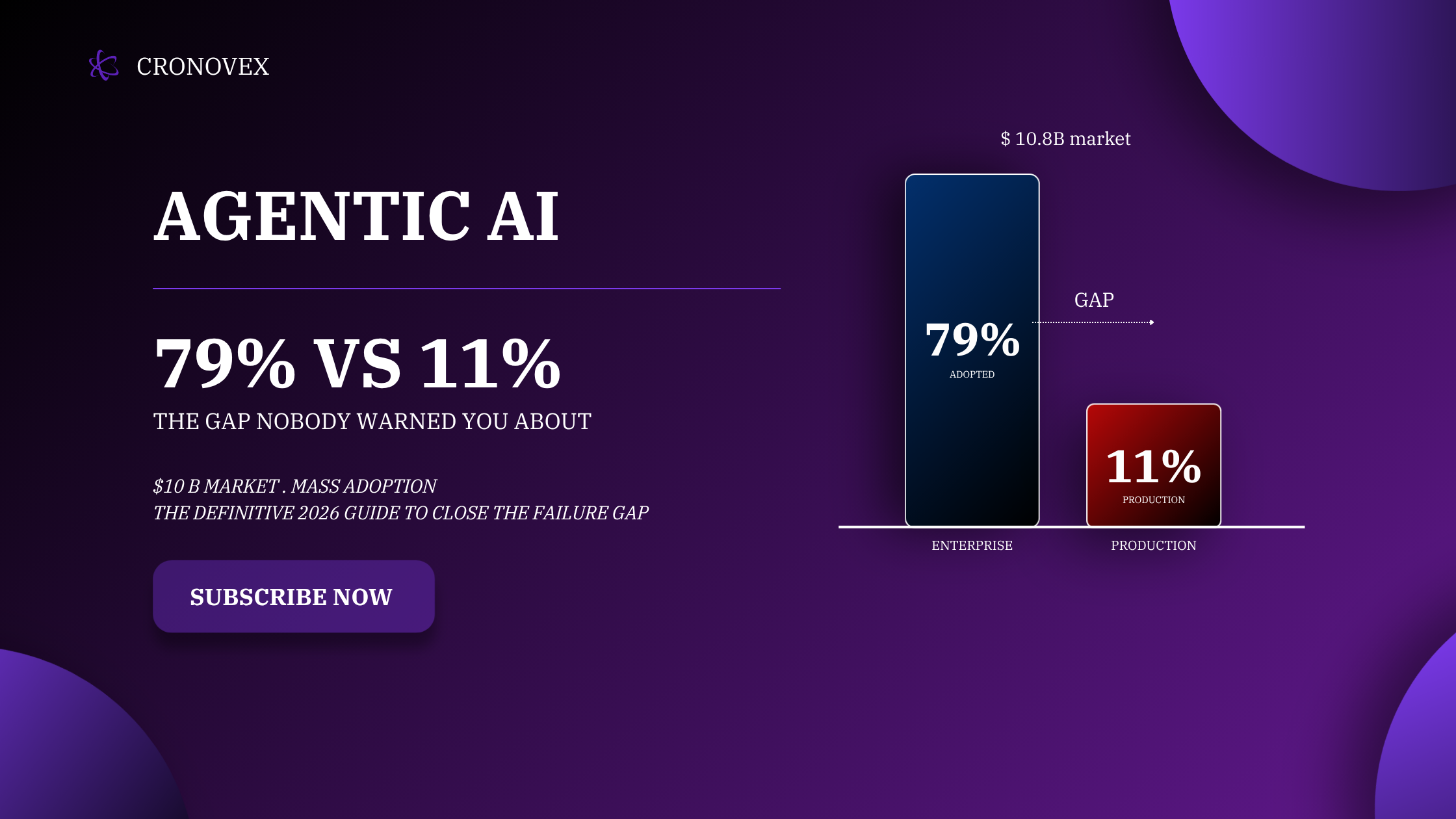
Agentic AI in 2026: The Enterprise Deployment Gap
79% of enterprises have adopted AI agents. Only 11% run them in production. The $10.8B market is real — but so is the failure rate. This is the definitive 2026 guide to closing the gap.
Physical AI & Humanoid Robots 2026: The $165 Billion Revolution
Physical AI is the #1 investment trend of 2026. Tesla Optimus, Boston Dynamics Atlas & Figure AI are deploying in real factories now. Here's the complete market analysis.
The Rise of Autonomous Orchestration
How self-optimizing logic is replacing traditional automation and redefining enterprise efficiency.